
Boxing is a sport that is composed of repeated bouts of high intensity efforts and has been described as an aerobically dominant sport: 77% aerobic and 23% anaerobic (Davis, Leithäuser & Beneke, 2014). In this section we are going to discuss the physiology behind the energy systems and what adaptations we need to bring about to improve our aerobic capacity and ultimately be able to perform for longer in the ring before fatigue sets in.
Increase in Oxidative Enzymes
When looking to improve aerobic performance, the optimal method is found to be by increasing the number and activity of skeletal muscle oxidative enzymes (Bylund et al., 1977). By increasing the number and activity of these enzymes; in particular, Citrate Synthase (CS), the rate at which the Krebs cycle is able to process will increase; ultimately, resulting in more ATP being produced and therefore more energy for you!
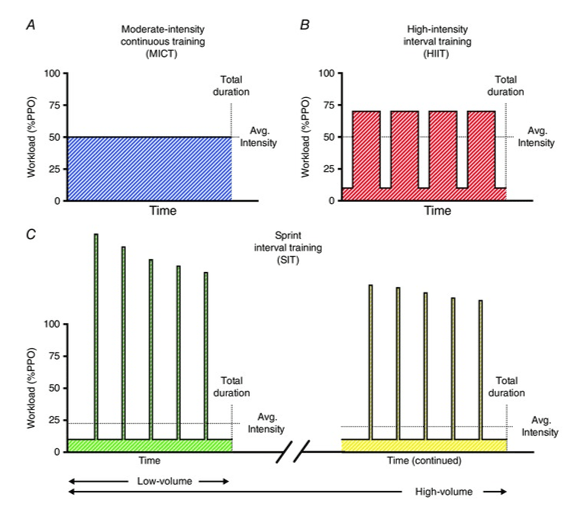
There are many ways to increase the number and activity of oxidative enzymes, such as: continuous aerobic training (CT), high intensity interval training (HIIT) and sprint interval training (SIT). All 3 methods have been proven to elicit similar improvements in oxidative enzymes; so, which one should you do?
The most effective method to gain these adaptations is notably through SIT compared to the other 2 methods (CT & HIIT). This is due to the amount of time spent training required to bring about such adaptations. One study compared weekly time commitments between SIT and CT and found that ~1.5 hours of SIT per week elicited similar adaptations of oxidative enzymes as ~4.5 hours of CT per week did (MacInnis & Gibala, 2016).
Increase in PGC-1α
Peroxisome proliferator-activated receptor-y coactivator-1α (PGC-1α) is a protein that is essentially responsible for mitochondrial biogenesis (creation of new mitochondria) and increases oxidative capacity through improved fat metabolism; basically, improving aerobic endurance. PGC-1α has also been reported to be responsible for the remodelling of already existing mitochondria (Austin & St-Pierre, 2012). An overall increase in volume and density of mitochondria will subsequently result in an increase of ATP production; which again means more energy!
PGC-1α has been heavily reported to be induced through cold water immersion therapy (CWI) and fasting. However, it may not be feasible to fast if you are preparing for a competition! Previous studies have also found SIT and HIIT to both increase PGC-1α activity.
References:
Austin, S., & St-Pierre, J. (2012). PGC1 and mitochondrial metabolism – emerging concepts and relevance in ageing and neurodegenerative disorders. Journal Of Cell Science, 125(21), 4963-4971. doi: 10.1242/jcs.113662
Bylund, A., Bjurö, T., Cederblad, G., Holm, J., Lundholm, K., & Sjöström, M. et al. (1977). Physical training in man. European Journal Of Applied Physiology And Occupational Physiology, 36(3), 151-169. doi: 10.1007/bf00421747
MacInnis, M., & Gibala, M. (2016). Physiological adaptations to interval training and the role of exercise intensity. The Journal Of Physiology, 595(9), 2915-2930. doi: 10.1113/jp273196
 SiB
SiB 